In short
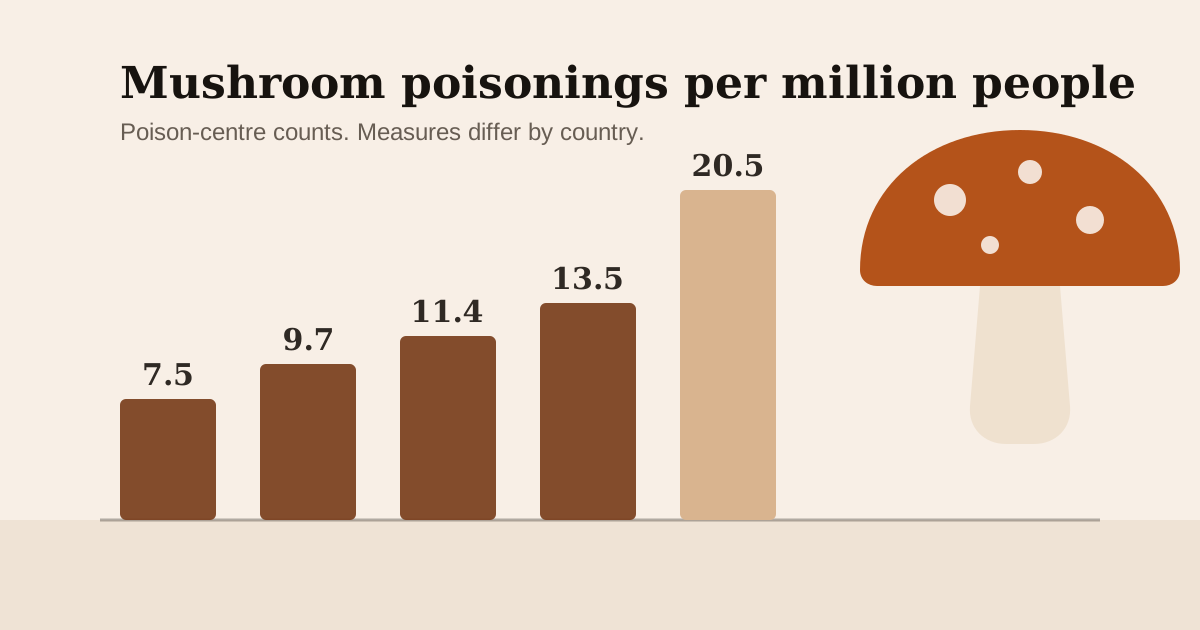
- Ireland's National Poisons Information Centre (NPIC) dealt with 40 cases of suspected mushroom poisoning in 2024 and 51 in 2023. That works out at 7.5 to 9.7 per million people.
- The Dutch poisons centre (NVIC) was consulted about an average of 203 patients a year between 2021 and 2025, and 243 in 2025. That's 11.4 to 13.5 per million, the closest like-for-like comparison with Ireland.
- France counts only people who had symptoms. In the second half of 2024 there were 1,363, or 20.5 per million people in mainland France, in six months.
- Germany's regional poison centres answer more than 3,000 enquiries about mushrooms a year, at least 36 per million. Hospital statistics show 280 to 680 inpatient treatments a year (3.4 to 8.1 per million).
- None of these numbers is a full count of everyone poisoned. Each one records who contacted a service, or who was admitted to hospital.
What each country counts
Each country's figure comes from a different system, so it's worth seeing how they differ before comparing anything.
| Country | Source | What is counted | Period | Who can contact the service |
|---|---|---|---|---|
| Ireland | NPIC, Beaumont Hospital [1][2] | Calls, and the cases (people) behind them, whether or not the person had symptoms | Calendar year | Public and healthcare professionals; the public made 55.1% of all NPIC enquiries in 2024 [3] |
| Netherlands | NVIC, UMC Utrecht [6] | Patients who may have eaten mushrooms, about whom the NVIC was consulted | Calendar year | The service is aimed at doctors and other healthcare providers [11] |
| France | Anses, using poison-centre records [4][5] | People with symptoms after eating mushrooms; mainland France only; cases with no causal link removed | 1 July to 31 December | Public and professionals |
| Germany | BfR [7][8]; federal health reporting (GBE) via BfR [9] | (a) Enquiries about mushrooms to the regional poison centres; (b) inpatient hospital treatments | (a) a year, stated as "over 3,000"; (b) annual range over ten years | Public and professionals |
Ireland and the Netherlands: the closest match
Ireland and the Netherlands both report people about whom their poisons centre was contacted, whether or not they became ill. That makes them the closest pair, though not an exact one.
| Country | Period | Patients/cases | Population (1 Jan) | Per million |
|---|---|---|---|---|
| Ireland | 2023 | 51 | 5,271,395 (2023) | 9.7 |
| Ireland | 2024 | 40 | 5,351,681 (2024) | 7.5 |
| Netherlands | 2021–2025 average | 203 | 17,811,291 (2023, mid-period) | 11.4 |
| Netherlands | 2025 | 243 | 18,044,027 (2025) | 13.5 |
Working: cases ÷ population × 1,000,000. For example, 40 ÷ 5,351,681 × 1,000,000 = 7.5. Populations are from Eurostat [12].
On these figures the Dutch rate is roughly 20% to 80% higher than Ireland's. There's one structural difference that makes the gap more striking. Ireland's NPIC takes calls directly from the public, who made 55.1% of all its enquiries in 2024 [3]. The NVIC's service is aimed at doctors and other healthcare providers [11]. You might expect a public line to log more worried-but-well callers, yet Ireland's count is still the lower one.
The Dutch figures also break out the meal cases. About one in seven NVIC reports involved wild mushrooms that had been picked and cooked as a meal, an average of 29 patients a year from 2021 to 2025 (1.6 per million). By early October 2026 that count was already at 27. Amatoxin poisoning (the type caused by death caps) was strongly suspected in 12 of those 27, and the NVIC knows of one death this year [6]. There is no published Irish equivalent of this breakdown.
France: symptomatic cases only
France has the most detailed public record of the four. Anses publishes a report every season. Between 1 July and 31 December 2024, 1,363 people with symptoms contacted a poison centre in mainland France. Of these, 3.1% were severe and three people died [4]. Divided by mainland France's population of 66.4 million (INSEE, 1 January 2025 [13]), that's 20.5 per million in six months.
| Season | Cases | Deaths |
|---|---|---|
| 2016 | 607 | 0 |
| 2017 | 1,386 | 2 |
| 2018 | 1,125 | 1 |
| 2019 | 2,025 | 3 |
| 2020 | 1,365 | 5 |
| 2021 | 1,340 | 4 |
| 2022 | 1,923 | 2 |
| 2024 | 1,363 | 3 |
Sources: 2016–2022, Anses report 2023-VIG-0127 [5]; 2024, Anses [4]. We couldn't find the 2023 season total in an Anses publication. The 2016–2022 average is 1,396 a season, or about 21 per million.
This season is running at a similar pace. According to Anses figures reported by AFP, French poison centres had recorded more than 700 cases from the start of September to 20 October 2026 [10].
Germany: enquiries and hospital stays
Germany's figures are the least precise. The Federal Institute for Risk Assessment (BfR) said in 2022 that the regional poison centres answer "over 3,000" enquiries about mushrooms a year [7]. Its 2026 release says "several thousand" [8]. Taking 3,000 as a floor gives at least 36 enquiries per million people. That's roughly three to four times Ireland's 8.4 to 10.8 calls per million, but enquiries are not people. One case can generate several calls, and the German figure may include questions that aren't about a specific exposure.
German hospital statistics, as cited by the BfR, show 280 to 680 inpatient treatments for mushroom poisoning a year over the past decade, with between zero and seven deaths a year with that diagnosis [9]. That's 3.4 to 8.1 admissions per million. We haven't found published Irish hospital data on mushroom poisoning, so this measure has no Irish counterpart.
Rough comparison (not like-for-like)
The table below sets the four headline rates side by side. They measure different things, so read the gaps as rough orders of magnitude, not exact differences.
| Country | Measure | Per million |
|---|---|---|
| Ireland | NPIC cases, 2024 / 2023 | 7.5 / 9.7 |
| Ireland | Estimated symptomatic cases, 2023 (about half of 51) | about 5 |
| Netherlands | NVIC patients, 2021–25 average / 2025 | 11.4 / 13.5 |
| France (mainland) | Symptomatic cases, Jul–Dec 2024 | 20.5 |
| Germany | Poison-centre enquiries (floor) | 36 or more |
| Germany | Inpatient hospital treatments (range) | 3.4–8.1 |
The France comparison is the most telling. In 2023, about half of Ireland's 51 cases had no symptoms when the NPIC was contacted [1]. That leaves roughly 25 symptomatic cases, or about 5 per million over a full year. France counted about four times that rate in half a year.
Sidebar: identification apps
Anses recorded 30 people poisoned in the 2022 season after identifying their mushrooms with a smartphone app, across 19 meals. In 2021 the figure was six [5]. Both Anses [4] and Ireland's NPIC [2] say people shouldn't rely on identification apps.
Method and caveats
- Rates are counts divided by the population on 1 January, multiplied by one million. Populations for Ireland, the Netherlands and Germany are from Eurostat table tps00001 (accessed 29 October 2026), with the year shown beside each figure. For France we used INSEE's mainland population of 66.4 million on 1 January 2025, because Anses counts mainland France only.
- The Irish case and call figures come from the NPIC as reported by The Irish Times [1]. The NPIC's 2024 annual report [3] doesn't separate out mushrooms. Its "about 50 calls a year" figure [2] is consistent with them.
- The French figures cover July to December only. Poisonings in the first half of the year aren't included, so the French rate is a minimum for the full year.
- The German hospital range and deaths come from federal health reporting (GBE), as cited by the BfR and reported by dpa [9]. We haven't yet checked them against the GBE tables.
- Poison-centre counts depend on how willing people are to call, how well known the service is, and who is allowed to call. They aren't a measure of how many people were poisoned.
- Small numbers move a lot from year to year. Ireland's figure fell from 51 to 40 between 2023 and 2024.
About the data request
The NPIC doesn't publish a yearly series for mushroom enquiries. We have asked the NPIC for its mushroom enquiry and case counts for 2015 to 2025, broken down by symptoms and severity where available. We'll update this piece when we receive them.
Sources
- The Irish Times, "National helpline fields more than 100 calls over suspected mushroom poisoning", 8 July 2025. https://www.irishtimes.com/health/2025/07/08/national-helpline-fields-more-than-100-calls-over-suspected-mushroom-poisoning/ (accessed 29 October 2026)
- Waterford News & Star, "National Poison Information Centre reports increase in enquiries in 2025", 28 August 2026. https://www.waterford-news.ie/national-poison-information-centre-reports-increase-in-enquiries-in-2025_arid-109770.html (accessed 29 October 2026)
- National Poisons Information Centre of Ireland, Annual Report 2024. https://poisons.ie/wp-content/uploads/2025/12/2024-Annual-Report-FINAL.pdf (accessed 29 October 2026)
- Anses, "Cueillette des champignons : vigilance face aux risques d'intoxications", 25 September 2025. https://www.anses.fr/fr/content/cueillette-des-champignons-vigilance-face-aux-risques-dintoxications ; English version: https://www.anses.fr/en/content/mushroom-picking-beware-of-the-risks-of-poisoning (accessed 29 October 2026)
- Anses, "Surveillance saisonnière des intoxications accidentelles par des champignons en France métropolitaine : bilan des cas enregistrés par les Centres antipoison entre le 1er juillet 2022 et le 31 décembre 2022", rapport d'étude n° 2023-VIG-0127, July 2023. https://www.anses.fr/system/files/Toxicovigilance2023VIG0127Ra.pdf (accessed 29 October 2026)
- NVIC (UMC Utrecht), "Consumptie van zelfgeplukte paddenstoelen kan resulteren in ernstig leverfalen!", 15 October 2026. https://nvic.umcutrecht.nl/nl/nieuws/consumptie-van-zelfgeplukte-paddenstoelen-kan-resulteren-in-ernstig-leverfalen (accessed 29 October 2026)
- BfR, press release 32/2022 "Pilze: Verwechslungen können lebensgefährlich sein", 6 September 2022. https://www.bfr.bund.de/presseinformation/pilze-verwechslungen-koennen-lebensgefaehrlich-sein/ (accessed 29 October 2026)
- BfR, press release 27/2026 "Pilze: Verwechslungen können tödlich enden", 30 September 2026. https://www.bfr.bund.de/presseinformation/pilze-verwechslungen-koennen-toedlich-enden-2026/ (accessed 29 October 2026)
- Pharmazeutische Zeitung (dpa), "Pilzvergiftungen – Über hundert schwere Fälle pro Jahr", 19 October 2026. https://www.pharmazeutische-zeitung.de/ueber-hundert-schwere-faelle-pro-jahr-171236/ ; also apotheke adhoc, 20 October 2026: https://www.apotheke-adhoc.de/nachrichten/detail/panorama/einige-hundert-schwere-pilzvergiftungen-pro-jahr/ (accessed 29 October 2026)
- AFP via Techniques de l'Ingénieur, "Saison des champignons : déjà plus de 700 intoxications recensées depuis septembre", 20 October 2026. https://www.techniques-ingenieur.fr/actualite/breves-afp/saison-des-champignons-deja-plus-de-700-intoxications-recensees-depuis-septembre-165098/ (accessed 29 October 2026)
- NVIC, "Werkwijze van het NVIC". https://nvic.umcutrecht.nl/nvic/nl/werkwijze-van-het-nvic ; NVIC Jaaroverzicht 2025, Informatieverstrekking: https://nvic.umcutrecht.nl/2025/nl/informatieverstrekking-2025 (accessed 29 October 2026)
- Eurostat, "Population on 1 January" (tps00001), data updated 27 October 2026. https://ec.europa.eu/eurostat/databrowser/view/tps00001/default/table (accessed 29 October 2026)
- INSEE, Insee Première n° 2033, "Bilan démographique 2024", 14 January 2025. https://www.insee.fr/fr/statistiques/8327319 (accessed 29 October 2026)
The data is free to reuse under CC BY 4.0 with credit to fungi.ie and a link to this page. Download the CSV.